
Introduction
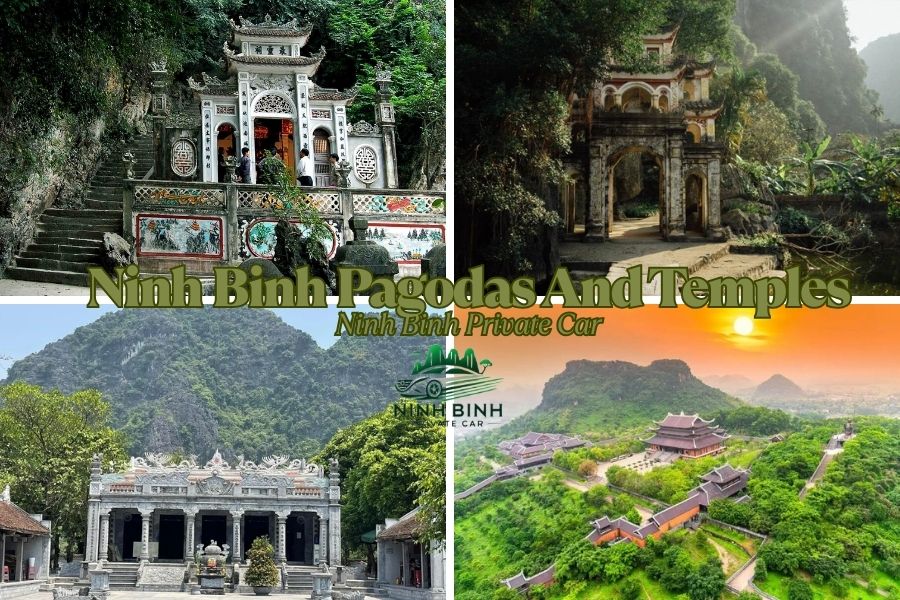
Ninh Binh, a spiritual land famous for its pagodas and temples that are hundreds or thousands of years old. This is not only a charming land of mountains and water but also one of the famous places with a very famous spiritual tourism. This place converges many sacred, ancient religious works with rich historical and cultural values, from pagodas to temples associated with folk culture. In this article, let’s learn about the Ninh Binh Pagodas and Temples in this land with Ninh Binh Private Car. If you are someone who likes to learn about religion, culture, and history, this article is definitely for you.
Ninh Binh Pagodas
Bai Dinh Pagoda in Ninh Binh, Vietnam

First, we will learn about the most famous pagoda in Ninh Binh and Vietnam, which is Bai Dinh Pagoda. When talking about Ninh Binh Pagodas and Temples, you definitely cannot miss this pagoda. It can be said that this is a temple with records as one of the largest temples in Vietnam. The pagoda is located on the slopes of Bai Dinh Mountain, in the Tam Coc – Bich Dong mountain range.
The pagoda has two main areas: new Bai Dinh pagoda and old Bai Dinh pagoda. With more than 1,000 years of history, the ancient Bai Dinh Pagoda bears the mark of Buddhism during the Tran Dynasty. There are smaller pagodas here with tiles covered with green moss. This pagoda is located deep in the mountains with many natural caves used for worship. The cave space makes everything dark and mysterious.

If you leave the old pagoda area, you will immediately come to the new pagoda area built from 2003 until now. This pagoda is majestically designed, has an impressive scale, with many unique architectural works. Some works include the 10-meter-high bronze statue of Buddha Tathagata, the tallest bronze Buddha statue in Southeast Asia. The Arhat corridor is 500 meters long, with 500 Arhat statues carved from green stone and many other things.

Bai Dinh Pagoda in Ninh Binh is not only a spiritual place but also a very famous spiritual tourist destination. The pagoda brings a feeling of quiet and peace, dispels daily fatigue, and brings peace to the soul.
Non Nuoc Pagoda

Non Nuoc Pagoda, a famous pagoda in the Ninh Binh Pagodas and Temples. If you ask a local person about Ninh Binh Pagodas and Temples, someone will definitely point you to this pagoda. The pagoda has ancient, majestic beauty and poetic, charming natural scenery. In 1962, the Ministry of Culture, Sports and Tourism ranked this temple as a national historical and cultural relic.
Non Nuoc Pagoda was built during the reign of King Ly Nhan Tong, and is a pagoda with a long history, associated with many important events in the nation’s history. The pagoda was once a place to organize many important Buddhist activities, where monks and intellectuals came to practice and preach.

Non Nuoc Pagoda is an ancient pagoda located at the foot of Non Nuoc Mountain, a mountain also associated with major turning points of the times. Non Nuoc Pagoda, with an area of about 2000 m2, is surrounded by stone walls. The buildings inside the pagoda have an ancient design style, the main hall with double-layered tiles using red and blue tiles curved upwards and carved with dragon and phoenix images.
The pagoda grounds are also filled with green, with many ornamental plants inside. These include trees hundreds of years old, as well as small bonsai trees. In addition, inside the pagoda grounds, there are also statues made of stone. Among them are the large Guan Yin statue and the Maitreya Buddha statue.
Non Nuoc Pagoda is an attractive spiritual tourist destination, imbued with the history and culture of Ninh Binh. If you have the opportunity to come to Ninh Binh, do not forget to visit this ancient pagoda to admire the ancient beauty and immerse yourself in the stunning natural scenery here.
Bich Dong Pagoda

During the journey to explore the Tam Coc – Bich Dong Boat Tour, visitors cannot miss Bich Dong Pagoda, a sacred ancient pagoda. Bich Dong Pagoda is one of the oldest pagodas of Ninh Binh. The pagoda was rebuilt in 1428 during the reign of King Le Loi, and still preserves its most quintessential features until modern times.

Bich Dong Pagoda was built in the style of the letter “三”, including three buildings: Lower Pagoda, Middle Pagoda, and Upper Pagoda. Lower Pagoda is located at the foot of the mountain, Trung Pagoda is located halfway up the mountain, and Thuong Pagoda is located on the top of the mountain. The unique thing is that mountains, caves, and pagodas complement each other, making the pagoda blend in with the natural landscape.
Tourists visiting the pagoda will have to climb stairs along the mountainside to reach higher pagodas. Passing by Trung Pagoda, visitors will enter the Dark Cave with a bell hanging there. Visitors can ring the bell three times to purify their souls.
Golden Pagoda Ninh Binh

Vang Pagoda (Golden Pagoda) is a very special pagoda, located in the middle of Whale Lake, surrounded by water and mountains. The pagoda was built on the foundation of Bat Long Pagoda – an ancient pagoda built by King Le Dai Hanh more than 1000 years ago. The pagoda has an area of 28 hectares, including a small island and a mainland area.
The Golden Pagoda is built in an octagonal shape, with equal sides rotating in eight directions. This symbolizes the worship of the 8 kings of the 12 ancient warlords of Bat Long Pagoda. The main face of the pagoda faces East, the direction of the former capital Thang Long. The entire pagoda uses green stone for construction, and the carved details bear the mark of Vietnam.
The pagoda has a main room connected by a corridor. The middle space is also the main space where the 12m high bronze statue of Shakyamuni Buddha is worshiped. The two compartments on both sides worship the kings under the 12 warlords and the Buddhas and Guan Yin.

Especially at night, when the pagoda’s lighting system is active, the pagoda will glow. The bright golden light emanating from the pagoda is also the reason why the pagoda is called the Golden Pagoda.
Am Tien Pagoda

Am Tien Pagoda, also known as Am Tien Cave, will be the next landmark in the journey to discover the Ninh Binh pagodas and temples. The pagoda is only about 10km from the city center, so visitors can visit the pagoda easily.
The pagoda was built on a limestone mountain, with two parts: inside and outside a cave located halfway up the mountain. Before the pagoda was established, this was the place that King Dinh Tien Hoang used to execute serious criminals. Inside the cave, there are tigers, and below the pond, there will be crocodiles.

The prisoners will be thrown down and eaten by tigers and crocodiles. Because there are so many dead souls here, there have been many legends that people passing by here often hear wailing sounds.
Then, in order to neutralize the grudges of the dead, Zen Master Nguyen Minh Khong established the pagoda here. The pagoda is also named Am Tien. Every day, he sits in the cave chanting sutras to help those souls salvation.

It has beautiful natural scenery and is a tourist destination for those who want to try relaxation and healing. Coming to Am Tien Pagoda, visitors will admire the beauty of pristine nature. In addition, you can visit the cave and see the stalactites in the cave.
In 2014, Am Tien Pagoda was restored, rebuilt, and became an attractive tourist destination.
Nhat Tru Pagoda

If mentioning ancient pagodas in Ninh Binh, it is impossible not to mention Nhat Tru Pagoda, dating back more than 1000 years. Under the reign of King Le Dai Hanh, this pagoda was built, and now it has become an important relic. The pagoda was built on a flat land, facing west, and the most important thing in the pagoda is the Stone Sutra Column.
The column is over 3 meters high, has an octagonal cross section, and is made of monolithic stone. On the pillar is engraved the Śūraṅgama Sūtra, one of the important scriptures of Buddhism. The main hall of the pagoda was built in the style of the character Dinh (丁), consisting of 3 compartments. The middle space is a place to worship Buddha, the right space worships Mother Goddesses, and the left space worships gods.

Every year, on the full moon day of the first lunar month, the pagoda will hold a festival associated with the Hoa Lu Ancient Capital Festival. Initially, a palanquin procession will be held from King Dinh Tien Hoang temple to Nhat Tru pagoda. After that, there will be sacrificial rituals to pray for favorable weather and good harvests. This is the traditional cultural beauty of the people of Ninh Binh and has existed for a long time.
Dich Long Pagoda

Dich Long Pagoda, also known as “Nam Thien De Tam Dong”, is also known as the 3rd most beautiful cave in Vietnam. This Pagoda – Cave is said to have been built in 1740, initially named Nham Son Co Am Tu Cave. Later, the pagoda was renamed Dich Long, meaning “mountain flute”. Because the sound of the wind blowing and hitting the cliffs in the mountain cave creates clear, interesting sounds, like the sound of a flute.
The pagoda was built in a large cave, with two areas divided by the entrance: Bright Cave and Dark Cave. Sang Cave is about 20 meters wide, 10 meters high, and about 30 meters deep. In the cave, there are many stalactites and stone columns that are vividly shaped. Inside the cave, there is a shrine to Buddha Shakyamuni and Bodhisattva Avalokiteshvara.

Dark Cave is smaller than Bright Cave, about 10 meters wide, 5 meters high, and about 20 meters deep. There are also many stalactites and stone columns in the cave, but they are not decorated as much as Sang Cave. Inside the cave, there is a shrine to Amitabha Buddha.
Duyen Ninh Pagoda

Another ancient pagoda, under the reign of King Dinh Tien Hoang, in the list of Ninh Binh Pagodas and Temples, is Duyen Ninh Pagoda. This is a special pagoda for those who have not found their other half. Single people will visit the temple and make offerings to pray for love, hoping to find their other half.
The pagoda belongs to the western citadel of the Hoa Lu ancient capital relic site, along with the Nhat Tru pagoda. Besides praying for love, the pagoda is also a famous place for Buddhist meditation activities for believers in Ninh Binh.
Ninh Binh Temple
Besides the pagodas, Ninh Binh is also famous for a number of temples to worship gods and national heroes. Next in Ninh Binh Pagodas and Temples, let’s explore more about the temples in Ninh Binh with Ninh Binh Private Car.
Dinh And Le Temples

Hoa Lu Ancient Capital was the capital of three dynasties. When the last dynasty, the Ly dynasty, moved the capital to the Thang Long Citadel. During the Ly Dynasty, King Ly Du Tong built and expanded Dinh and Le Temples.
These are two temples worshiping two heroic kings in Vietnamese history, King Dinh Tien Hoang and King Le Dai Hanh. King Dinh Tien Hoang was the first king to unify the territory and ascend to the throne. As for King Le Dai Hanh, he was the one who protected his country from the invasions of the Song Dynasty in China. At the same time, he also introduced policies to help improve people’s lives.

At the temple of these two kings, many extremely unique treasures dating back thousands of years are still preserved. Among them can be mentioned the Long Sang at the temple of King Dinh Tien Hoang, considered a national treasure.
If visitors have time, they can visit Dinh and Le Temples to burn incense to commemorate these two kings. At the same time, learn more about history, as well as interesting stories from the past.
Thai Vi Temples

After abdicating and passing the throne to his son, King Tran Nhan Tong built the Thai Vi Temple as a place for himself to practice. The temple is made entirely of green stone from the mountains of Ninh Binh. This is a place of spiritual significance as it is a place to worship the kings of the Tran Dynasty, such as Tran Thai Tong, Tran Thanh Tong, and Tran Nhan Tong. In addition, generals are also worshiped here, such as Tran Hung Dao and Tran Quang Khai.
The special thing about this temple is thanks to the artisans who sculpted these structures. Although almost all of the structures are made of stone, the artisans have breathed life into the structures. Thanks to that, a unique beauty is created for each work.
Hoa Lu Tu Tran

In Ninh Binh, there is also a legend about four gods guarding the four directions, East, West, South, and North. They are “Hoa Lu Tu Tran,” who are the protectors of the Ninh Binh land from ancient times to the present. To the east is the god Thien Ton, to the west is the god Cao Son, to the south is the god Quy Minh, and to the north is the god Khong Lo.

These gods are worshiped in large temples located in four different directions. In turn, there will be Thien Ton Cave, Cao Son Temple, Quy Minh Temple, and Thanh Nguyen Temple. Among them, the three gods are not real and appear in legends, and Saint Nguyen is a Zen master Nguyen Minh Khong.
Each god has its own interesting legend. If visitors have time, they can visit all four relics mentioned above to learn more about the legends in this sacred land.
Conclusion
Ninh Binh is a land with a long cultural history, with many famous landscapes. Visitors to Ninh Binh will discover a system of massive pagodas and temples. The pagodas in Ninh Binh are not only religious architectural works, but also highly valuable historical and cultural relics. Temples are also places to commemorate Vietnam’s heroes. They all contribute in no small part to creating the history and culture of Vietnam today.